
Light microscope passes a beam of light through the cell to enable us to see the cell. To work out the magnification of a light Microscope by carrying out this calculation
Electron microscopes pass a beam of electrons through the cells. They enable us to see much more detail. The electron microscope have a better resolving powers then light microscope.
Resolving power depends on the wavelength of the electromagnetic radiation (for example light or electrons)
Resolving Power= Wavelength/2
Microscopes
Microscopes have been in use for approximately 350 years. Hans and Zaccharias Janssen are credited with constructing the first usable one in the 1590s.
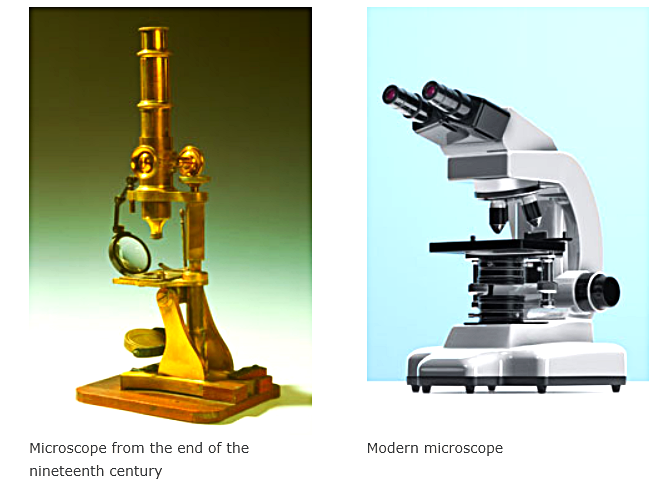
Early microscopes did not magnify to a great extent and scientists have worked hard to improve this. We now have modern light microscopes that can magnify 1,500 times and electron microscopes that can magnify up to two million times. This has allowed scientists to see things such as cells in much greater detail. As a result our understanding of their structure and function has improved.
Magnification calculations
We can calculate the length of a magnified object by using the magnification of the lens.
Length of object = length of magnified object ÷ magnification
For example, if a specimen appeared 10mm in length under a microscope with a magnification of 1,000 times, the calculation of the actual length would be:
Length of object = 10 ÷ 1000 = 0.01 mm

